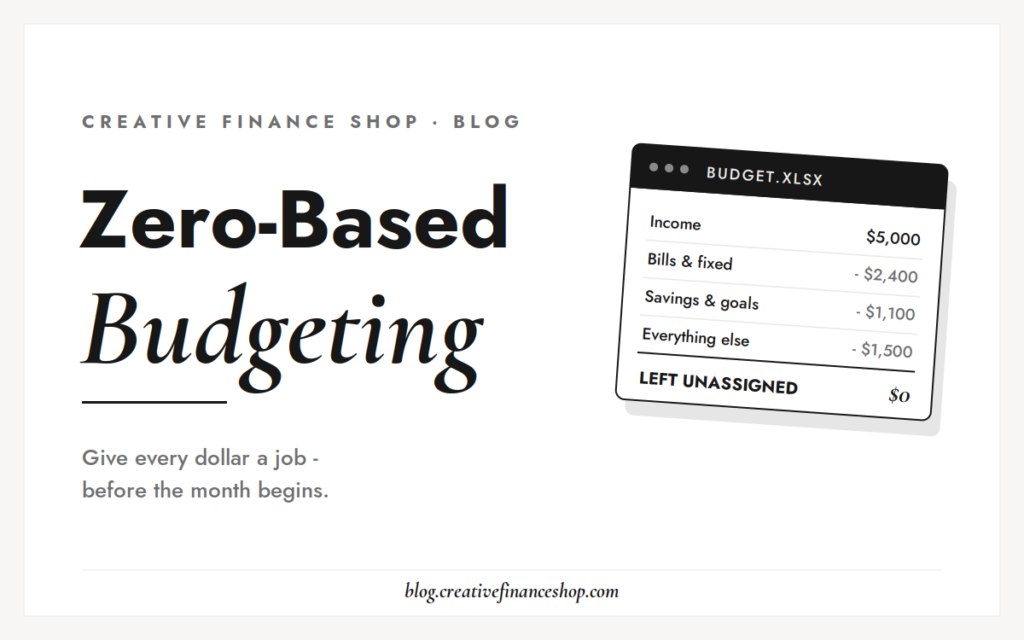
Most budgets are written backwards. They wait until the month is over, look at the bank statement, and ask where it all went. A zero-based budget flips the question. It asks where every dollar should go, and does not stop until there is an answer for all of them.
Done properly, this is not a monthly chore you start from scratch twelve times a year. It is an annual plan you build once, then recalibrate each month against what actually happened. That is exactly how a well-run company manages its money.
What zero-based actually means
The rule is one sentence: income minus everything you assign equals zero.
If you expect to bring in $60,000 this year, you give all $60,000 a job. Rent gets a job. Groceries get a job. Debt payments, savings, the kids’ activities, vacation, and fun money all get assigned. When you are done, there is no vague pool of whatever is left.
Zero-based does not mean your bank account hits zero. It means zero dollars are unassigned. Savings is a job. A buffer is a job. The money is all still yours; it just all has a name tag.
Why annual, not monthly
Budgeting one month at a time has a blind spot: your year is not twelve identical months. December has holidays. August has back-to-school. Insurance renews in March. Annual subscriptions arrive when they arrive. A month-by-month budget meets each one as a fresh emergency. An annual budget sees them on day one.
No CFO builds January’s budget in January. They build the full year in advance because the point of a plan is to see expensive months coming while there is still time to prepare.
Building the annual plan
- Start with real take-home income for the year.
- Map the non-negotiables across all twelve months.
- Assign your goals before fun money.
- Give everything else a job until the year hits zero.
The monthly recalibration
The plan you write in January will be wrong by February. Something will run over. Something else will come in under. That is why the system has a monthly rhythm.
- Enter your actuals.
- Read the variances.
- Recalibrate the months ahead.
This monthly rhythm turns the budget from a January resolution into an operating system. The plan gets smarter because every month it absorbs another round of reality.
The mistakes to skip
- Too many categories. Start with 12 to 15 and split categories only when one keeps surprising you.
- Building the year and never looking at it again. The annual plan without monthly recalibration is just a detailed wish.
- Treating a variance as a moral event. An overage is a line item, not a verdict.
Plan the year once. Recalibrate in minutes.
Our Zero-Based Budget Tracker is the system from this post, prebuilt: map all twelve months, enter actuals as you go, and watch every variance and recalibration ripple through the year automatically. Works in Excel and Google Sheets. Pay once, use it every year.