Say “balance transfer” and most people picture someone drowning in credit card debt, scrambling to escape a high interest rate. That’s one use, and a good one. But it’s only half the story.
Used carefully, a balance transfer is also a liquidity tool. It can buy you time, protect your emergency fund, and smooth out lumpy expenses, all without paying interest during the promotional period. This post reframes how you think about balance transfers, walks through five practical uses, and lays out the costs and rules that keep the strategy safe.
What a Balance Transfer Actually Does
A balance transfer moves a balance from one credit card to another, usually to a card offering a 0% or low introductory APR for a set number of months.
Three numbers define every offer:
The promotional APR. Often 0% for a limited time.
The promotional period. How many months the low rate lasts. Terms vary by card.
The balance transfer fee. Typically a percentage of the amount transferred, commonly in the range of 3% to 5%.
When the promo ends, any remaining balance starts accruing interest at the card’s regular APR, which is usually high.
The Reframe: Debt Tool vs. Liquidity Tool
The traditional view treats a balance transfer as a rescue from expensive debt. The liquidity view asks a different question: How much is it worth to keep my cash available for the next year?
Liquidity means having cash you can reach quickly. When you pay a large expense straight from savings, your cushion shrinks immediately. When you put that expense on a card and move it to a 0% balance transfer offer, you pay it back gradually while your savings stay mostly intact.
You’re choosing when to pay the balance, for a known, fixed fee.
5 Smart Ways to Use a Balance Transfer as a Liquidity Tool
1. Protect Your Emergency Fund After a Big Expense
A car repair, a medical bill, or a sudden trip can wipe out months of saving. If the expense is already on a credit card, a balance transfer lets you spread repayment over the promo period instead of draining your emergency fund in one hit.
Your cushion stays in place for the next surprise while you pay off this one on a steady schedule.
2. Bridge Irregular Income
Freelancers, contractors, commission earners, and seasonal workers often have strong years with uneven months. A balance transfer can bridge a slow stretch so a temporary dip in income doesn’t turn into a cash crunch. When a larger payment arrives, you pay down the balance.
This only works if the income is genuinely expected. Don’t use it to cover a gap you can’t see the end of.
3. Smooth a Large One-Time Cost
Some costs are planned but lumpy: moving expenses, a new laptop for work, annual insurance premiums. Rather than absorbing it all in one month, a balance transfer spreads the cost into equal monthly payments that fit your budget.
4. Keep Cash Earning Interest (With Realistic Expectations)
If your savings earn interest, keeping cash in the account while you repay at 0% can partly offset the fee. But the math is often thin, so treat this as a bonus, not the main reason.
Illustrative example:
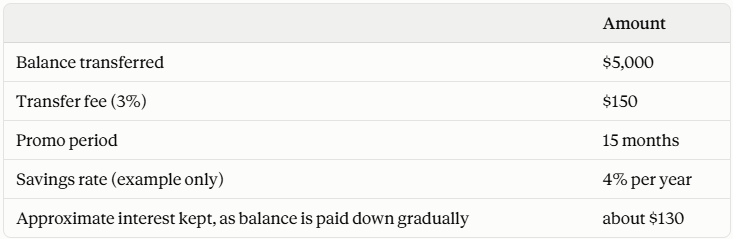
Because you pay the balance down each month, you don’t earn interest on the full $5,000 the whole time. In this example, the interest roughly cancels out the fee. The real value is the liquidity, not a profit.
Rates and fees vary. Run your own numbers before deciding.
5. Buy Time During a Life Transition
Changing jobs, relocating, or waiting on a large reimbursement can leave you temporarily short. A balance transfer gives you a defined window to get settled without paying interest, as long as you know the money to repay it is coming.
The Real Costs to Weigh
A balance transfer is never free. Be clear on these before you move a dollar:
The transfer fee is paid upfront. It’s added to your balance immediately.
The regular APR after the promo is steep. Anything left when the promo ends starts costing interest.
New purchases may not be interest-free. On many cards, carrying a transferred balance can mean new purchases on that same card start accruing interest right away, unless the card also offers a 0% promo on purchases. The simplest fix: don’t use the balance transfer card for new spending.
Payment order matters. If a card holds balances at different rates, amounts above the minimum payment generally go to the highest-rate balance first. Minimum payments may be applied differently.
Applying for a new card is usually a hard pull. The impact is usually small and temporary, but it’s worth timing carefully.
Watch for deferred interest. Some store cards offer “no interest if paid in full” deals. If you don’t pay everything by the deadline, interest can be charged back to the original purchase date. A true 0% intro APR doesn’t work that way. Read the terms.
A Quick Break-Even Check
Before a liquidity-driven balance transfer, ask: Is keeping this cash available worth the fee?
If the fee is $150 and it keeps $5,000 in your emergency fund for over a year, many people will say yes, especially if the alternative is going without a cushion. If you have plenty of savings and no need for flexibility, paying the expense directly may be simpler and cheaper.
Rules That Keep a Balance Transfer Safe
Build a payoff plan on day one. Divide the total balance, including the fee, by the number of promo months minus one. Paying on that schedule clears the balance a month early.
Automate the payment. Set autopay for your planned monthly amount, not just the minimum. The minimum usually won’t clear the balance in time.
Mark the promo end date. Put it on your calendar and in your tracker. Missing it is the most common, and costliest, mistake.
Don’t add new spending to the card. Keep the balance transfer card for the transfer only.
Keep your two-card rotation separate. If you use the two-card system for float, leave those cards out of it. The rotation depends on paying in full each month.
Remember utilization. Moving a balance doesn’t reduce what you owe overall. A new card does add available credit, which may help utilization, but a large transferred balance on one card can push that card’s usage high. See how a higher credit limit affects your score.
The Consumer Financial Protection Bureau has a helpful overview of how balance transfers and their fees work.
When a Balance Transfer Isn’t the Right Tool
Skip it if:
- You can’t realistically repay the balance before the promo ends
- You tend to add new spending when credit is available
- The fee is higher than the value of the flexibility you’d gain
- You’re planning a major loan application soon and don’t want a new inquiry
- The expense is ongoing rather than one-time
How the Balance Transfer Tracker Keeps You on Track
The Balance Transfer Tracker is designed to make this strategy safe and predictable. It helps you:
- Record the transfer amount, fee, and promo APR
- Calculate the monthly payment needed to finish before the promo ends
- Count down the months left in each promotional period
- Log every payment and show the remaining balance
- Flag if you’re falling behind schedule
With one view of every deadline and payment, a balance transfer stays a liquidity tool instead of becoming expensive debt. Download the Balance Transfer tracker
Frequently Asked Questions
Can I use a balance transfer if I don’t have debt?
Yes. Some card issuers let you send a balance transfer directly to your checking or savings account (sometimes called a “direct deposit” balance transfer or convenience check), so you don’t need existing card debt to use one.
How much does a balance transfer cost?
Most cards charge a fee, commonly 3% to 5% of the amount transferred. Some offers have no fee, but they’re less common. Check the card’s terms.
Can I transfer a balance between two cards from the same issuer?
Usually not. Most issuers only accept balance transfers from cards issued by other banks. But if your card lets you transfer the amount to a checking or savings account, you can still use it: move the funds into your bank account, then use that cash to pay down the balance on your other card from the same issuer.
Does a balance transfer hurt my credit score?
Applying for a new card typically involves a hard inquiry, which may cause a small, temporary dip. The new card’s limit can lower overall utilization, which may help.
What happens if I don’t pay it off before the promo ends?
The remaining balance starts accruing interest at the card’s regular APR. That’s why a payoff plan and a tracked end date are essential.
Conclusion: Pay for Time, Not Interest
A balance transfer isn’t only an escape hatch for debt. Used with a plan, it’s a way to buy time for a known, fixed fee, keeping your savings intact and your cash flow steady. The keys are simple: know the fee, make a payoff schedule, automate the payments, and never lose track of the promo end date.
Start by asking whether keeping cash available is worth the fee for you. If it is, set up your transfer in the Balance Transfer tracker and let it tell you exactly what to pay each month.
This article is for educational purposes and isn’t financial advice. Review your card terms carefully and choose products that fit your own situation.