If you have a credit card, you’ve probably seen two dates:
Statement closing date
and
Payment due date
They sound like they should mean the same thing.
They don’t.
And understanding the difference can help you avoid late payments, better manage your cash flow, and make smarter decisions about when to use your credit card.
In simple terms:
Your statement closing date tells you when your billing period ends.
Your payment due date tells you when you need to make your payment.
Let’s break it down.
What Is a Statement Closing Date?
Your statement closing date is the last day of a credit card billing cycle.
Think of your billing cycle as a month-long bucket.
Throughout the cycle, you put purchases into the bucket.
When the closing date arrives, the credit card company closes that bucket and creates your statement.
Your statement typically shows things such as:
- Purchases you made
- Payments you made
- Credits or refunds
- Fees, if applicable
- The balance for that statement period
- The minimum payment required
- Your payment due date
So, if your statement closes on the 10th, the activity that has posted during that billing cycle is generally included in the statement that closes around that date.
Once the cycle closes, a new billing cycle begins.
What Is a Payment Due Date?
Your payment due date is different.
This is the date by which you need to make at least the required payment on your credit card account.
For example:
Statement closing date: August 10
Payment due date: September 5
The statement closes on August 10.
Then you have a period of time before the payment for that statement is due.
Think of it this way:
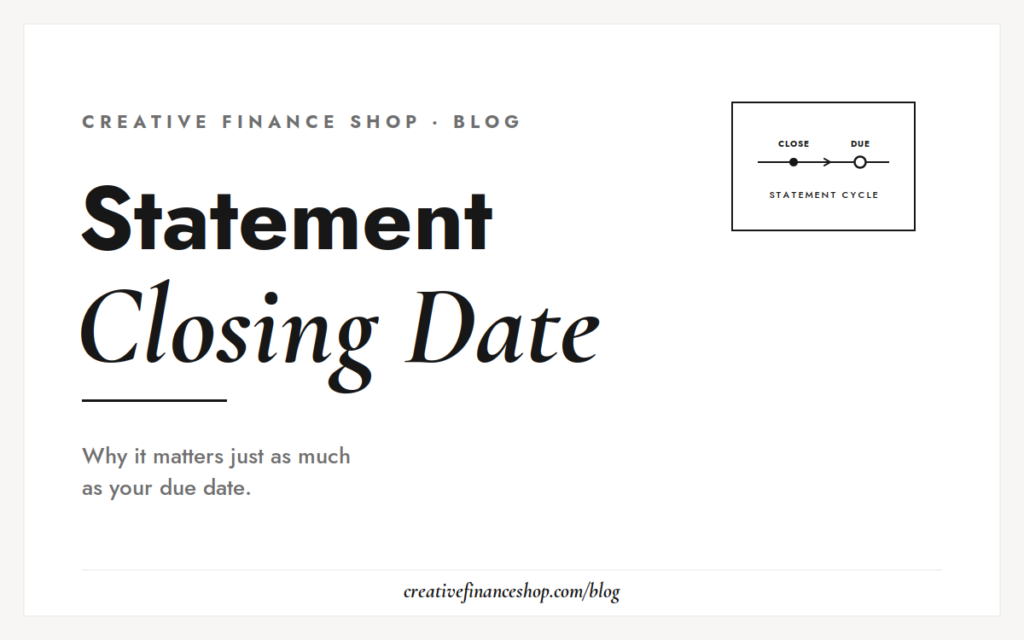
Closing date = The bill is created.
Due date = The bill needs to be paid.
That’s the easiest way to remember it.
A Simple Real-Life Example
Let’s say your credit card statement closes on the 10th of every month.
During the billing cycle, you make these purchases:
- $100 groceries
- $50 gas
- $200 furniture
- $75 restaurant
- $25 subscription
Your total is $450.
When the statement closes on August 10, those posted transactions will be included in your August statement.
Your statement will then say:
Statement balance: $450
Payment due date: September 5
The statement closing date and due date are two separate parts of the same process.
Why Does the Difference Matter?
You might be thinking:
“If I know my due date, why should I care about the statement closing date?”
Because the closing date affects which purchases appear on which statement.
And that can affect how long you have before those purchases are due.
This becomes especially useful when you’re making a large, planned purchase.
The Closing Date Determines Which Statement Gets the Purchase
Imagine your statement closes on August 10.
You make a $2,000 purchase on August 9.
If the transaction posts before the cycle closes, it may appear on the statement ending August 10.
That means it could be part of the balance due in the upcoming payment period.
Now imagine you make the same $2,000 purchase on August 11.
That’s just after the statement closed.
The purchase will generally fall into the new billing cycle.
It may not appear on a statement until the next statement closing date.
That can give you significantly more time before the purchase’s statement balance is due.
Same purchase.
Same credit card.
Same $2,000.
Different timing.
That’s why understanding your statement’s closing date can be valuable.
Statement Closing Date vs. Due Date
Here’s a quick comparison:
| Statement Closing Date | Payment Due Date | |
| What is it? | End of the billing cycle | Deadline for payment |
| What happens? | Your statement is generated | Your payment is due |
| Does it determine what appears on your statement? | Yes | No |
| Can you make purchases after it? | Yes | Yes |
| Why does it matter? | Helps you understand your billing cycle | Helps you avoid late payments |
The two dates work together, but they serve completely different purposes.
What Happens After the Statement Closes?
Once the statement closes, your credit card enters a new billing cycle.
This is important.
Suppose your statement closes on August 10.
Your next billing cycle starts after that.
If you make a purchase on August 11, that purchase generally belongs to the new cycle.
It won’t normally be part of the statement that already closed on August 10.
Instead, it will generally appear on the next statement.
This is why the day shortly after your statement closes can sometimes be a useful time to make a planned large purchase.
The “Golden Moment”
If you use your credit card responsibly, the period immediately after your statement closes can be what we call the Golden Moment.
Why?
Because you’re at the beginning of a new billing cycle.
A purchase made around this time can potentially have more time before it appears on a statement and reaches its payment deadline.
For example:
Statement closes: August 10
Purchase: August 11
The purchase generally goes into the new billing cycle.
If the next statement closes around September 10 and the payment is due in early October, you could potentially have several weeks between making the purchase and having to pay that statement.
The exact number of days depends on your card but you can get a maximum of 51 to 55 days if you purchase on August 11. However, if you made the purchase on Aug 9, you receive about 22 to 26 days before payment is due.
The principle is simple:
Early in the billing cycle = potentially more time.
Late in the billing cycle = potentially less time.
What Is Credit Card Float?
This brings us to another useful concept: credit card float.
Credit card float is basically the amount of time between making a purchase and needing to pay for it.
Let’s say you buy something today and don’t need to pay the statement balance until 40 days later.
You have roughly 40 days of float.
If you make the same purchase at a different point in your billing cycle and only have 25 days before the payment deadline, your float is shorter.
This doesn’t change how much you owe.
It simply changes how long you have before the payment is due.
Why More Float Can Help
Having more time can help with cash flow.
For example, suppose you have $3,000 in savings and need to make a $2,000 purchase.
You could immediately remove the $2,000 from your savings account.
Or, if appropriate for your situation, you could use a credit card and keep the $2,000 in an interest-bearing savings account until the credit card payment is due.
If you have the money available and pay the credit card balance in full and on time, this can give your cash more time to remain available and potentially earn interest.
The important part is having the money already.
Credit card float should not be used as a way to spend money you don’t have.
Don’t Confuse Float With Free Money
This is one of the most important things to understand.
A longer float does not mean you have more money.
If you buy a $2,000 television, you still owe $2,000.
You haven’t saved $2,000.
You’ve simply delayed when you need to pay it.
Think of it as getting more time – not getting a discount.
And if you don’t pay your balance as required, interest can quickly erase any benefit you were hoping to get.
What If You Carry a Balance?
Be careful.
If you regularly carry a balance from month to month, you may not get the same interest-free benefit on new purchases that you would when paying your statement balance in full.
Your card’s grace-period rules matter.
Before relying on statement timing, read your card agreement and understand how your specific account works.
How to Find Your Statement Closing Date
You don’t have to guess.
You can usually find your statement closing date by checking:
Your Credit Card Statement
Look at your most recent statement.
Your billing period or statement date should be listed somewhere on the document.
Your Credit Card App
Many credit card apps show your billing cycle information.
Your Online Account
Log into your credit card account and look through your statement or account details.
Ask Your Card Issuer
If you can’t find the information, call the number on the back of your card and ask:
“What is my statement closing date?”
You can also ask:
“What is my payment due date?”
Knowing both is useful.
What If the Closing Date Changes?
Don’t assume your closing date will always be the same in every situation.
Credit card accounts can have different billing arrangements, and issuers may make changes under certain circumstances.
The safest approach is to check your current statement or account information rather than relying on a date you remember from months ago.
What About Pending Transactions?
This is another reason not to cut things too close.
A transaction can be pending before it officially posts to your account.
So if your statement closes on August 10, a purchase made on August 10 isn’t necessarily guaranteed to appear on that statement.
It may depend on when the transaction posts.
If timing is important, don’t assume that making a purchase on the exact closing date will produce a particular result.
A few days of buffer can make your planning easier.
The Closing Date Can Also Help You Understand Your Spending
Your statement closing date isn’t only useful for timing purchases.
It can help you understand your spending habits.
For example, you can use your statements to look at:
- How much you spend each billing cycle
- Where your money goes
- Whether you’re consistently spending more than planned
- Whether you’re using your credit card for necessities or impulse purchases
- How quickly you pay your balance
This can give you a clearer picture of your financial habits.
A Simple Strategy for Planned Large Purchases
If you’re planning a large purchase and already have the money available, here’s a simple process:
Step 1: Find your statement closing date.
Know when your billing cycle ends.
Step 2: Find your payment due date.
Know when your payment is required.
Step 3: Check your current balance.
Make sure you aren’t accidentally adding a large purchase to an already high balance.
Step 4: If timing is flexible, consider buying shortly after your statement closes.
This may give you a longer potential float.
Step 5: Keep the money available.
Don’t spend the money you planned to use to pay the card.
Step 6: Pay your statement balance responsibly.
Don’t let a timing strategy turn into credit card debt.
A Simple Example to Remember
Here’s the entire concept in one example.
Your card:
Statement closes: August 10
Payment due: September 5
You want to make a $1,500 purchase.
Purchase on August 9
The purchase may be included in the statement closing August 10.
You may have a shorter period before that balance is due.
Purchase on August 11
The purchase generally falls into the new billing cycle.
It may not appear until the next statement closes.
That can give you more time before payment is due.
Again, the exact timing depends on when the transaction posts and the terms of your particular card.
The Bottom Line
Your statement closing date and payment due date are not the same thing.
The simplest way to remember the difference is:
Closing date = the billing period ends and your statement is prepared.
Due date = your payment deadline.
Understanding the closing date can help you know which purchases will appear on which statement and how much time you may have before payment is due.
And if you’re making a large purchase that you can already afford, knowing where you are in your billing cycle can help you use your credit card more strategically.
Just remember:
A longer payment window isn’t extra money. It’s extra time.
Use that time responsibly, keep the cash available, and pay what you owe on time.
Once you understand your statement closing date, your credit card starts to look a little less confusing – and a lot more predictable.