Budgeting can feel complicated.
You may have tried making a budget before, only to find yourself asking questions like:
- Where did all my money go?
- Why do I still run out of money before payday?
- How much should I actually save?
- Can I afford this purchase?
- Why does my income look good on paper, but my bank account doesn’t?
The problem may not be that you earn too little. You may simply not have a clear plan for where your money should go.
That’s where zero-based budgeting comes in.
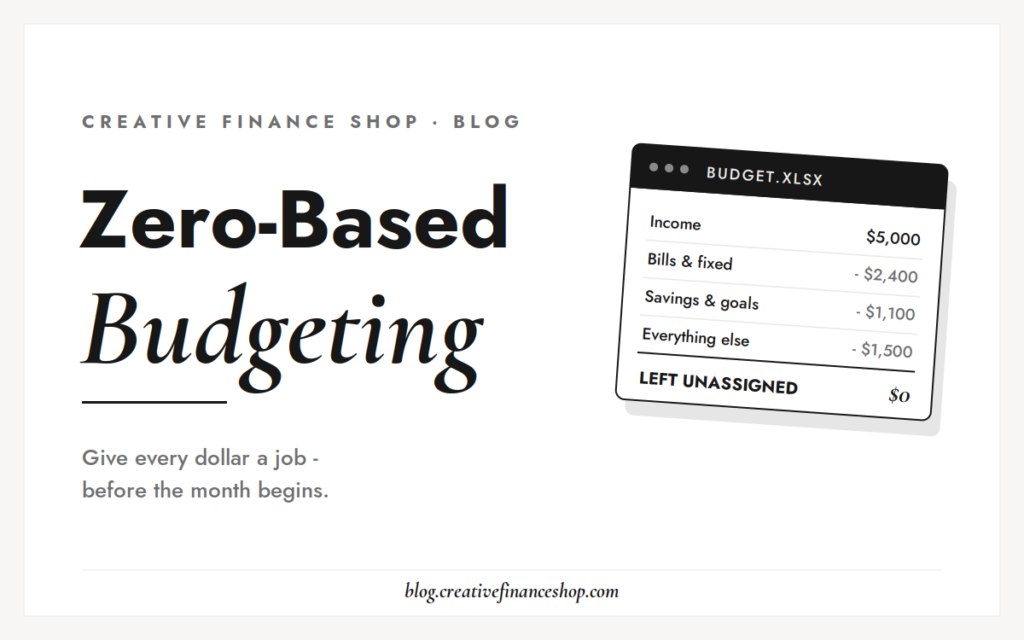
Zero-based budgeting is a simple approach to managing your money where every dollar of income is given a specific job before you spend it.
And don’t let the name scare you. You don’t need to be a financial expert or love spreadsheets to use it.
Let’s break it down in plain English.
What Is Zero-Based Budgeting?
Zero-based budgeting means planning your income so that, after you assign money to all your expenses, savings, investments, and other priorities, nothing is left without a purpose.
The basic formula is:
Income – Planned Expenses – Savings – Investments – Other Goals = $0
That doesn’t mean you should literally spend every dollar.
In fact, quite the opposite.
If you earn $4,000 this month and want to save $800, that $800 gets a job too. You are simply telling your money where to go before the month begins.
For example:
| Category | Amount |
| Monthly income | $4,000 |
| Rent | $1,200 |
| Groceries | $500 |
| Utilities | $250 |
| Transportation | $300 |
| Insurance | $200 |
| Savings | $600 |
| Investments | $400 |
| Entertainment | $200 |
| Other expenses | $350 |
| Total | $4,000 |
You’ve now given the entire $4,000 a job.
Nothing is “left over” by accident.
Why Is It Called Zero-Based?
The word “zero” can be confusing.
Zero-based budgeting does not mean your bank account should reach zero at the end of every month.
It simply means:
Income minus all planned allocations equals zero.
Think of your income like a group of employees.
Instead of letting everyone wander around the office wondering what to do, you give each person a specific assignment.
Your dollars work the same way.
One dollar pays the rent.
Another dollar buys groceries.
Another goes toward your emergency fund.
Another goes toward investing.
Another can be used for fun.
The goal is to make sure every dollar has a purpose.
Why Should You Give Every Dollar a Job?
Without a plan, money tends to disappear.
You receive your paycheck, pay a few bills, buy some things, go out a couple of times, and suddenly you’re wondering where the rest went.
Zero-based budgeting changes the order.
Instead of:
Earn → Spend → Hope there’s money left
You do:
Earn → Plan → Spend
That small change can make a big difference.
1. You Know Where Your Money Is Going
When every dollar has a job, you don’t have to guess whether you can afford something.
You already know how much you’ve set aside for groceries, entertainment, transportation, savings, and everything else.
2. Saving Becomes Part of the Plan
One of the biggest budgeting mistakes is treating savings as whatever happens to be left at the end of the month.
With zero-based budgeting, savings can be planned from the beginning.
Instead of saying:
“I’ll save whatever is left.”
You say:
“I’m putting $500 toward my savings goal this month.”
That’s a much more intentional approach.
3. You Can Spend Without Feeling Guilty
Budgeting doesn’t mean you can’t enjoy your money.
If you’ve already planned $200 for restaurants and entertainment, you can spend that money knowing it has a place in your budget.
A good budget isn’t designed to make you miserable.
It’s designed to help you spend your money on purpose.
4. You Spot Problems Before They Become Problems
Suppose you plan to spend $500 on groceries but regularly spend $700.
A zero-based budget makes that difference visible.
Now you can decide what to do about it.
Maybe you need to increase your grocery budget.
Maybe you need to reduce food waste.
Maybe eating out is actually the bigger issue.
The important thing is that you can see what’s happening.
How to Create a Zero-Based Budget
You don’t need a complicated system.
Here are the basic steps.
Step 1: Calculate Your Income
Start by figuring out how much money you expect to receive during the budgeting period.
For a monthly budget, include your expected take-home income.
If you have a regular salary, this may be easy.
If your income changes from month to month, use a conservative estimate rather than assuming you’ll earn your highest possible amount.
You can include things like:
- Salary
- Freelance income
- Side-hustle income
- Bonuses
- Tax refunds
- Other reliable income
The goal is to know how much money you actually have available to assign.
Step 2: List Your Fixed Expenses
Next, write down expenses that are usually the same every month.
These might include:
- Rent or mortgage
- Car payment
- Insurance
- Internet
- Phone bill
- Subscriptions
- Debt payments
These expenses are usually the easiest to plan because you already know what they cost.
Step 3: Estimate Your Variable Expenses
Now think about expenses that change from month to month.
Examples include:
- Groceries
- Gas
- Electricity
- Eating out
- Entertainment
- Clothing
- Personal care
Look at your previous spending if you can.
Your bank or credit card statements can be useful here.
Don’t try to create a perfect number. Start with a realistic estimate and adjust it as you learn more about your spending.
Step 4: Give Money to Your Financial Goals
This is where zero-based budgeting becomes especially useful.
Don’t just budget for today’s bills.
Give your money jobs that support your future too.
Consider categories such as:
- Emergency savings
- Retirement
- Investments
- Debt repayment
- Vacation savings
- Home down payment
- Education
- Giving
Even if you can only start with a small amount, make it part of the plan.
For example, if you earn $3,000 a month, you might decide that $300 goes toward savings and $150 toward investing.
Those dollars now have a job before you have a chance to spend them elsewhere.
Step 5: Add Personal Spending
Yes, you should budget for fun.
Create a category for things you enjoy.
Maybe that’s:
- Restaurants
- Movies
- Hobbies
- Shopping
- Travel
- Coffee
- Entertainment
The amount doesn’t have to be huge.
The point is to make room for enjoyment while keeping it within a limit you can afford.
Step 6: Subtract Everything From Your Income
Now add up all your planned categories.
Your goal is:
Income − All Planned Allocations = $0
If you have $200 left, don’t leave it sitting in a mysterious “whatever” category.
Give it a job.
You could put it toward:
- Savings
- Investing
- Debt
- A future purchase
- Giving
- Something you genuinely value
If you’re $200 over your income, you also have a job to do.
You’ll need to reduce some categories or find additional income.
What If Your Income Changes Every Month?
This is one of the most common concerns about zero-based budgeting.
If your income isn’t predictable, zero-based budgeting can still work.
Instead of budgeting based on your best month, create your plan using a realistic lower-end income estimate.
Then, when you earn more than expected, give the extra money a job too.
For example, suppose you expect to earn at least $3,000 but end up earning $3,500.
Don’t automatically treat the extra $500 as spending money.
You could decide ahead of time that extra income will be split between savings, debt repayment, investing, and fun.
The exact percentages are up to you.
The important thing is to make the decision intentionally.
What About Irregular Expenses?
Some expenses don’t happen every month.
You might pay car insurance twice a year, buy gifts during the holidays, or pay an annual subscription.
These expenses can wreck a budget when you forget about them.
The solution is to plan for them before they arrive.
For example, if you expect to spend $600 on gifts during the year, you could set aside $50 per month.
After 12 months:
$50 × 12 = $600
When the holiday season arrives, you already have the money.
This is sometimes called a sinking fund, but you can think of it simply as saving a little at a time for a known future expense.
Zero-Based Budgeting Doesn’t Mean You Have to Be Perfect
This is important.
Your first budget probably won’t be perfect.
You may underestimate groceries.
You may forget an annual bill.
You may spend more on transportation than expected.
That’s okay.
A budget is not a test you can fail.
It’s a plan that gets better as you learn more about your actual spending.
The goal isn’t to predict every penny perfectly.
The goal is to become intentional about where your money goes.
Common Zero-Based Budgeting Mistakes
Mistake #1: Making the Budget Once and Forgetting About It
A budget isn’t something you create once and never look at again.
Check your spending throughout the month.
If something changes, adjust the plan.
Mistake #2: Making the Budget Too Restrictive
If your budget leaves no room for anything enjoyable, you’re more likely to abandon it.
Give yourself a reasonable amount of guilt-free spending.
Mistake #3: Forgetting Savings
Don’t make savings an afterthought.
If building savings is important to you, give it a place in the budget from the beginning.
Mistake #4: Ignoring Irregular Expenses
Annual bills, car repairs, gifts, school expenses, and other occasional costs are still real expenses.
Plan for them.
Mistake #5: Giving Up After One Bad Month
Overspending doesn’t mean budgeting doesn’t work.
It means you have information you can use.
Ask yourself:
What caused me to go over budget?
Then adjust your plan.
A Simple Zero-Based Budget Example
Let’s say Sarah takes home $3,500 per month.
She creates this plan:
| Category | Amount |
| Rent | $1,000 |
| Utilities | $250 |
| Groceries | $450 |
| Transportation | $300 |
| Insurance | $200 |
| Debt repayment | $300 |
| Emergency savings | $400 |
| Investments | $250 |
| Entertainment | $150 |
| Personal spending | $100 |
| Miscellaneous | $100 |
| Total | $3,500 |
Sarah has now given every dollar a job.
She hasn’t said, “I’ll try to save what’s left.”
She has decided in advance that $400 will go toward emergency savings and $250 toward investments.
If she spends less than expected in one category, she can decide where those extra dollars should go.
That’s the power of having a plan.
Your Budget Is a Tool, Not a Punishment
One of the biggest mindset shifts with zero-based budgeting is understanding that a budget isn’t there to tell you that you can’t spend money.
It’s there to help you decide what your money is for.
You worked for your income.
You should know where it’s going.
If you want to travel, your budget can help you save for travel.
If you want to become debt-free, your budget can help you prioritize debt payments.
If you want to invest, your budget can make investing part of your routine.
If you want to enjoy more of your money today, your budget can make room for that too.
The goal is not to make every dollar disappear.
The goal is to make every dollar intentional.
Start Small
You don’t need to completely change your financial life overnight.
Start with one month.
Write down your expected income.
List your bills.
Estimate your everyday expenses.
Set aside money for savings and financial goals.
Add some money for fun.
Then make sure every dollar has a destination.
At the end of the month, look back at what actually happened.
What worked?
What didn’t?
Where did you overspend?
Where did you underestimate?
Use those answers to create a better plan for the following month.
Over time, budgeting becomes less about restricting yourself and more about knowing exactly what your money can do for you.
The Bottom Line
Zero-based budgeting is simply a way of saying:
“My money has a purpose before I spend it.”
You don’t need a six-figure income.
You don’t need complicated financial software.
You don’t need to be a math expert.
You just need to start paying attention to your money and make a plan for it.
When every dollar has a job, your money becomes easier to manage, your goals become clearer, and you have a better idea of whether your spending actually matches the life you’re trying to build.
Don’t wait until the end of the month to see where your money went. Give it a job before the month begins.